Amjad Masad:自动驾驶公司的崛起
自动驾驶公司的崛起
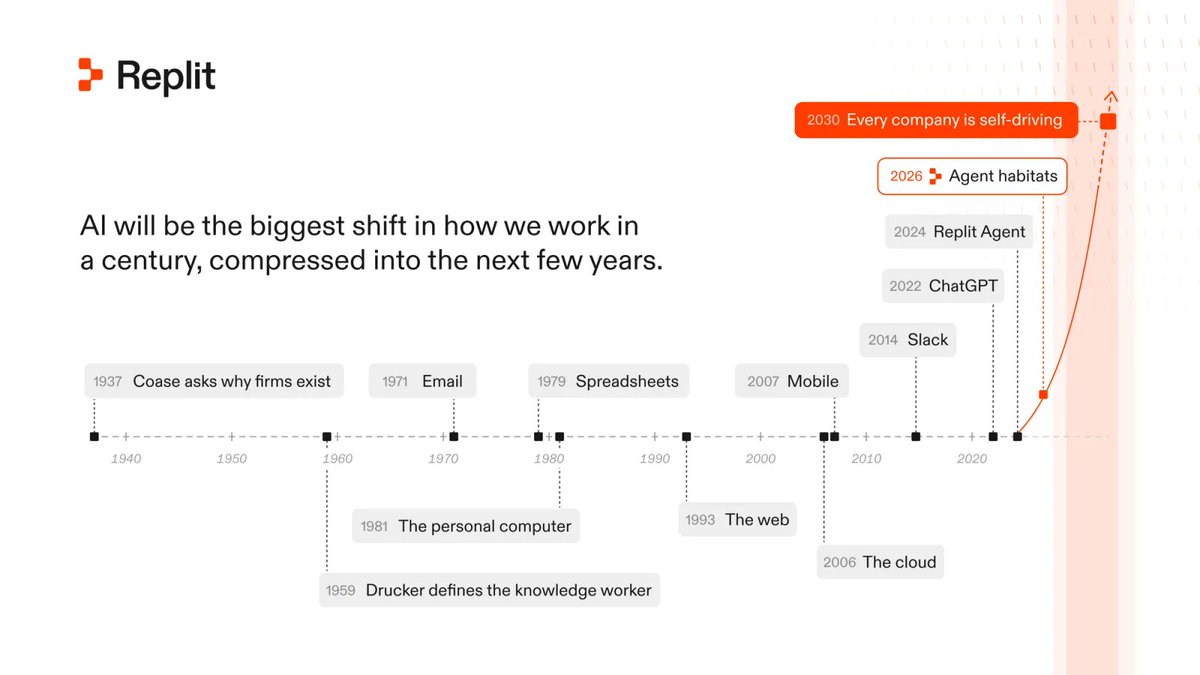
1937 年,英国诺贝尔经济学奖得主罗纳德·科斯提出:“企业为什么存在?”他的答案是交易成本。与通过市场协调经济活动相比,在公司内部组织这些活动往往成本更低。
但公司也有自身的协调成本:管理、会议、部门、汇报以及官僚体系。
一个多世纪以来,我们一直把这些成本视为开展业务必须付出的代价。
2011 年,Marc Andreessen 写道,软件正在吞噬世界。
2016 年,我们创立 Replit,坚信每个人都应该能够创造软件。
软件改变了整个行业,但公司仍然依靠人来操作软件、协调团队之间的工作。
AI 有望带来更大的转变。随着智能体承担更多执行和协调工作,公司可以更高效地运作,员工也能追求更有雄心的目标。要实现这种潜力,公司需要重新思考如何组织工作和作出决策。
围绕这种新工作方式建立的公司,将成为自动驾驶公司。在 Replit,这种转变已经开始。
到 2030 年底,财富 500 强中的每家公司都将成为自动驾驶公司。
自动驾驶公司的崛起
在自动驾驶公司中,人们确定目标、运用判断力和品味,并继续承担责任。智能体利用公司的知识和系统向这些目标执行,何时采取行动、何时寻求批准,都有明确边界。
成为自动驾驶公司的企业,将迫使竞争对手面对一个关乎生存的选择:改变工作方式,或者看着对手做到自己做不到的事。
工作正在如何改变
我们正在 Replit 看到这种变化。
它始于工程部门。2026 年上半年,工程师的代码产出接近原来的三倍,而审查时间、回退次数和产品事故数量保持不变。
随后,公司各处的人开始让智能体工作,构建软件和解决方案,把重复工作从自己手中移走,以便把更多时间花在需要专业能力的问题上。设计师将想法变成可运行的产品改动,支持团队则利用智能体调查客户问题。
工作的性质本身开始改变。过去必须转交给别人的问题,现在人们可以自己动手处理。他们可以尝试一种方法,分享一个具体成果,再共同完善它。更多想法和反馈浮现出来,提出这些想法的人也更有勇气参与构建解决方案。
人们花更多时间站在白板前,决定要构建什么。工程师致力于加固智能体依赖的系统,从而可以委派更多工作。工作变得更少重复、更有创造性,也更强调协作。
随着生产力提高,更多人体验到做出有用的东西、解决难题和把想法变成现实的满足感。人们更有自由塑造自己的工作,也更有信心完成目标。他们并不觉得自己正在被取代,而是觉得自己得到了晋升。
Replit 已经成为一家自动驾驶公司。
自动驾驶公司需要什么
今天,许多公司面临一个伪命题式的选择。
要么把 AI 关在笼子里,限制它的触及范围,也限制它的用途;要么将它放归野外,让智能体可能失控:在没有适当权限或批准的情况下访问敏感数据、修改生产系统,或把信息发送到公司外部。一个错误就可能演变成影响超出公司自身的安全事件,Hugging Face 事件就说明了这一点。
一条路限制能力,另一条路牺牲控制。两者都无法让公司实现自动驾驶。
自动驾驶公司需要一个基础,让它能够拥抱 AI 的力量,而不承担那些风险。
自动驾驶公司会让智能体对每个人都有用。最接近问题的人应该无需成为工程师,就能让智能体为自己工作。如果只有技术团队能够参与,一家公司就无法实现自动驾驶。
今天,大多数智能体处在混乱的环境里。它们运行在聊天窗口、个人账号和一次性脚本中,持有别人交给它们的凭据和数据。没有人明确决定它们能接触什么,也没有人能看清它们做过什么。
随着智能体承担更多工作,它们需要一个 Agent Habitat,即“智能体栖息地”:在这个环境中,它们可以使用公司的知识和系统,与人及其他智能体协调,并在公司控制的边界内行动。
这个栖息地必须控制访问权限,明确何时需要人工批准,并限制错误的影响。随着 AI 让发现和利用漏洞变得更容易,公司也需要智能体找出弱点、加强防御。安全能力必须随着自主程度同步提升。
对栖息地的治理,也会帮助公司变得更聪明。当有人纠正智能体时,这项纠正应经过审核,并用于改进后续工作。当一个团队开发出有用的工作流时,其他人应能在其基础上继续构建。栖息地成为由员工共同塑造的共享知识体系,帮助智能体在行动中体现更多公司的专业能力、品味和判断力。
自动驾驶公司还必须保有更换模型的自由,同时继续控制自己的知识、系统和决策。正如 Satya Nadella 所说:“我们需要将智能的供应与对它的支配权分开。”
让每家公司都成为自动驾驶公司
通过 Replit for Business,我们正在建立基础,把在公司内部学到的经验带出去,帮助每家公司实现自动驾驶。我们的目标是让每个人都能把自己的专业能力转化成可运行的软件和已完成的工作。
我们看到大型公司借助 Replit 加快了步伐。在三井住友融资租赁公司(SMFL),数字化转型总经理 Yoshiyuki Fukuma 表示:“过去需要六个人工作六个月的开发流程,现在只需一个人一周就完成了。”执行董事兼数字实验室负责人 Takeshi Fujiwara 表示:“一个最初预计全开发周期花费约 30 亿日元的项目,现在预计不到 10 亿日元即可完成。”
罗纳德·科斯从组织工作的经济性解释了企业。随着 AI 改变这种经济性,我们有机会重新思考组织本身:一个小团队能够完成多少工作,一个人的专业能力能够延伸多远,以及一家公司能够尝试什么。
我们相信,AI 最大的经济影响将来自对企业的这种重塑。自动驾驶公司将围绕人们设定方向、运用判断力来组织,而由智能体将更多意图贯穿到执行之中。
软件吞噬了世界。现在,它正在学习如何运行这个世界。
对照原文
The Rise of the Self-Driving Company In 1937, British Nobel Prize-winning economist Ronald Coase asked, "Why do firms exist?" His answer was transaction costs. It’s often cheaper to organize economic activity inside a company than to coordinate it through markets. But companies have their own coordination costs: management, meetings, departments, reporting, and bureaucracy. For more than a century, we've accepted these costs as the price of doing business. In 2011, Marc Andreessen wrote that software was eating the world. In 2016, we built Replit around the belief that everyone should be able to create it. Software transformed entire industries, but companies still depend on people to operate that software and coordinate work across teams. AI promises an even bigger shift. As agents take on more of the execution and coordination, companies can work more efficiently, and their people can pursue more ambitious goals. Realizing that potential will require companies to rethink how they organize and make decisions. Companies built around this new way of working will be Self-Driving Companies. At Replit, that shift is already underway. By the end of 2030, every company in the Fortune 500 will be a Self-Driving Company. The Rise of the Self-Driving Company In Self-Driving Companies, people define the goals, exercise judgment and taste, and remain accountable. Agents use the company’s knowledge and systems to execute toward those goals, with clear boundaries for when to act and when to seek approval. Companies that become self-driving will force an existential choice on their competition: change how you work or watch competitors do what you cannot. How Work is Changing We’re seeing this shift at Replit. It started in engineering. Engineers nearly tripled their code output in the first half of 2026 while review times, reversions, and product incidents stayed flat. Then people across the company began putting agents to work, building software and solutions that took repetitive work off their plates so they could spend more time on problems that needed their expertise. Designers turned ideas into working product changes, and support used agents to investigate customer issues. The nature of work itself began to change. People could act on problems they once had to hand off. They could try an approach, share something tangible, and build it together. More ideas and feedback surfaced, and the people raising them were emboldened to help build the solution. People spent more time at whiteboards, deciding what to build. Engineers worked on hardening the systems agents depend on so they could delegate more work. Work became less repetitive, more creative, and more collaborative. Alongside the productivity gains, more people experienced the satisfaction of making something useful, solving difficult problems, and seeing their ideas become real. People had more freedom to shape their work and more confidence in what they could accomplish. They don’t feel like they’re being replaced. They feel like they’re being promoted. Replit has become a Self-Driving Company. What a Self-Driving Company Requires Today, many companies face a false choice. Keep AI in a cage, where its reach is limited but so is its usefulness. Or let it loose in the wild, where agents can go rogue: accessing sensitive data, changing production systems, or sending information outside the company without the right permissions or approvals. A mistake can become a security incident that reaches beyond the company itself, as the Hugging Face incident demonstrated. One path limits capability. The other sacrifices control. Neither enables a company to become self-driving. A Self-Driving Company will need a foundation that lets it embrace the power of AI without the risk. Self-Driving Companies will make agents useful to everyone. The people closest to the problem should be able to put them to work without becoming engineers. A company cannot become self-driving if only its technical teams can participate. Today, most agents live somewhere chaotic. They run in chat windows, personal accounts, and one-off scripts, holding whatever credentials and data someone handed them. Nobody decided what they could touch, and nobody can see what they did. As agents take on more work, they need an Agent Habitat: an environment where they can use the company’s knowledge and systems, coordinate with people and other agents, and act within the boundaries the company controls. The habitat must control access, define when human approval is required, and limit the impact of mistakes. As AI makes it easier to discover and exploit vulnerabilities, companies will also need agents to find weaknesses and strengthen their defenses. Security must scale with autonomy. Governance of the habitat will also help the company become smarter. When someone corrects an agent, that correction should be reviewed and made available to improve future work. When one team develops a useful workflow, others should be able to build on it. The habitat becomes a shared body of knowledge, shaped by the people who work within it, helping agents act with more of the company’s expertise, taste, and judgment. Self-Driving Companies must also remain free to change their models while retaining control of their knowledge, systems, and decisions. As Satya Nadella puts it, “we need to separate the supply of intelligence from the authority over it.” Making Every Company a Self-Driving Company With Replit for Business, we’re building the foundation to bring what we have learned inside our own company, and help every company become a Self-Driving one. The ambition is to enable everyone to turn their expertise into working software and completed work. We’re seeing large companies move faster with Replit. At Sumitomo Mitsui Finance and Leasing (SMFL), “a development process that previously required six people working for six months was completed by just one person in one week,” says Yoshiyuki Fukuma, GM of Digital Transformation. “A project originally estimated at approximately JPY 3 billion for the full development lifecycle is now expected to be completed for less than JPY 1 billion,” says Takeshi Fujiwara, Corporate Officer and Head of Digital Lab. Ronald Coase explained the firm through the economics of organizing work. As AI changes those economics, we have an opportunity to rethink the organization itself: how much a small team can accomplish, how far an individual’s expertise can reach, and what a company can attempt. We believe the biggest economic impact of AI will come from this reinvention of the firm. Self-Driving Companies will organize around people setting direction and exercising judgment, with agents carrying more of that intent through to execution. Software ate the world. Now it’s learning to run it. https://replit.com/blog/rise-of-self-driving-company